
What Is a Purlin Rollforming Machine?

Understanding the Equipment Used to Produce C & Z Purlins
Purlins are an essential part of many metal building systems. These structural members support roof and wall panels while transferring loads to the primary structural frame.
Because purlins are produced in high volumes and often require precise holes, notches and cut lengths, a purlin rollforming machine provides an efficient way to manufacture them continuously from steel coil.
What Does a Purlin Rollforming Machine Do?
A purlin rollforming machine takes flat steel coil and progressively forms it into a finished C, Z or other structural profile.
The process typically includes:
Steel Coil → Uncoiling → Leveling/Feeding → Punching → Rollforming → Cutting → Finished Purlin
The machine gradually bends the steel through a series of forming stations until the final profile is achieved.
Unlike conventional fabrication methods that require separate cutting, punching and bending operations, a modern purlin rollforming line can combine these processes into one automated production system.

What Are C & Z Purlins?
C Purlins
C purlins have a C-shaped cross-section and are commonly used for:
Roof framing
Wall framing
Girts
Openings and framing applications
Metal building systems
Z Purlins
Z purlins have a Z-shaped cross-section and are widely used in metal building construction.
One advantage of the Z profile is that adjacent purlins can often be lapped at structural supports, providing efficient structural continuity.
The choice between C and Z purlins depends on the building design, structural requirements and engineering specifications.
How Does a Purlin Rollformer Work?
The process begins with a coil of structural steel loaded onto an uncoiler.
The steel is fed into the machine and accurately positioned before entering the rollforming section.
1. Coil Handling

The uncoiler supports the steel coil and supplies material to the production line.
Modern high-speed lines may use powered or servo-controlled uncoilers to precisely control material payout.
2. Punching
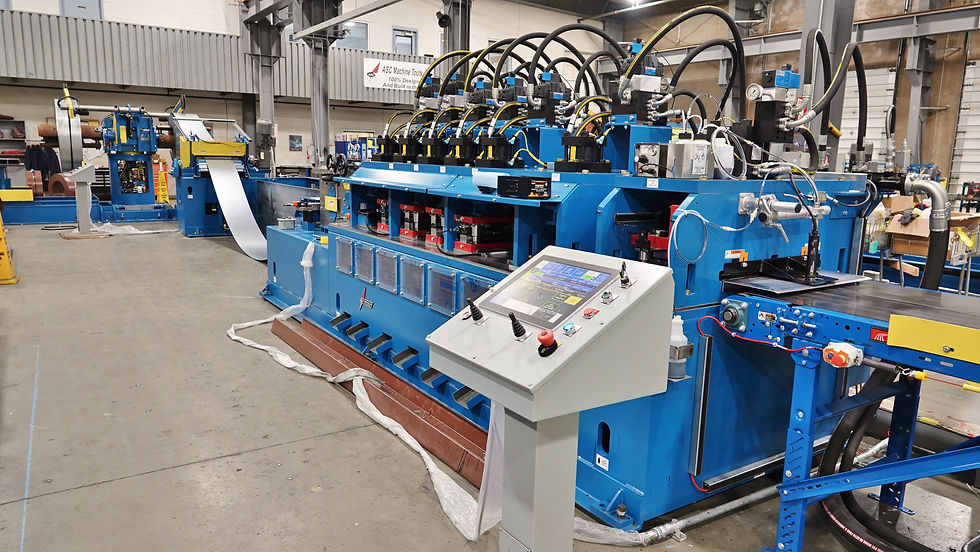
Holes and other features can be punched into the material before or during the rollforming process.
Typical features may include:
Bolt holes
Web holes
Flange holes
Slots
Notches
Automatic punching eliminates many secondary fabrication operations.
3. Rollforming

The flat strip passes through multiple forming stations.
Each station makes a small change to the material until the final C or Z profile is produced.
The number of forming stations depends on the profile geometry, material thickness, strength and required production speed.
4. Cutoff
Once the required length is reached, the finished purlin is cut to length. Depending on the machine configuration and product mix, purlin lines can use different cutoff methods.
Pre-Cut System: A cutoff die set integrated into the punching unit cuts the material into pre-cut blanks before the blanks are transported into the rollformer for forming.

Flying Cutoff System: For applications where continuous production is preferred, a flying cutoff located at the end of the rollforming line cuts the finished profile to the required length without stopping the material flow.
The optimal cutoff configuration depends on the profile, material thickness, required lengths, production speed and overall product mix. .
5. Stacking

Finished purlins can be automatically conveyed and stacked into bundles for handling, storage and shipment.
What Materials Can Be Rollformed Into Purlins?
Purlin rollforming machines are commonly designed to process structural steel in a range of gauges.
The exact material range depends on the machine design.
Material characteristics such as:
Thickness
Yield strength
Tensile strength
Coil width
Coating
must all be considered when engineering the rollforming machine and tooling.
A machine designed for lighter-gauge material may not be suitable for heavier structural applications.
Why Use Rollforming for Purlin Production?
High Production Rates
Purlin rollforming allows manufacturers to produce long lengths of structural profiles continuously from coil.
This can provide significantly higher productivity than manufacturing individual pieces through separate bending and punching operations.
Integrated Punching
Automated punching allows holes and other features to be incorporated directly into the production process.
This can eliminate secondary fabrication and reduce handling.
Consistent Profiles

Because the tooling controls the forming process, properly designed rollforming equipment can produce highly consistent profiles throughout a production run.
Flexible Lengths
Modern purlin lines can produce different cut lengths without manually cutting each piece.
Automation
A complete production line can automate much of the process, from coil handling through finished-product stacking.
Why Does Machine Design Matter?
Not all purlin rollforming machines are designed for the same production requirements.
When selecting a purlin line, manufacturers should consider:
Required purlin sizes
Material thickness
Material strength
Production speed
Punching requirements
Cut lengths
Changeover time
Coil weight
Automation requirements
Finished-product handling
The forming stands, shafts, tooling, drive system and punching equipment must all be properly engineered for the application.
The Evolution of Purlin Rollforming

Traditional high-speed purlin lines have often relied on a deep coil pit between the uncoiler and punching equipment.
The pit provides a material loop that helps accommodate rapid changes in material speed during punching and production.
New coil-handling technology is changing this approach.
ASC's Lightning Uncoiler™ uses an electrically driven, servo-controlled system to actively control coil payout and synchronize material delivery with the production line.

This technology makes it possible to design high-speed purlin production without the traditional coil pit, providing greater flexibility in facility layout while eliminating a large floor opening.
What Should You Look for in a Purlin Rollforming Machine?
When comparing purlin rollforming lines, look beyond the maximum machine speed.
Consider:
Production CapacityWhat is the actual net production rate?
Profile FlexibilityWhat sizes and shapes can the machine produce?
Punching CapabilityCan the required hole patterns be produced automatically?
ChangeoverHow quickly can the machine be changed from one profile or size to another?
Coil HandlingWhat coil weights and widths can the line accommodate?
AutomationHow much operator involvement is required?
Machine QualityWhat components, tooling and drive systems are being used?
Technical SupportWho will support the machine after installation?
Future UpgradesCan the equipment evolve as production requirements change?
A Purlin Line Is More Than a Rollformer
A modern purlin rollforming machine is really an integrated production system.
Coil Handling + Feeding + Punching + Rollforming + Cutting + Stacking
When these systems are properly engineered to work together, manufacturers can achieve high production rates while maintaining consistent quality and reducing manual operations.
Conclusion
A purlin rollforming machine transforms steel coil into finished C, Z and other structural profiles through a continuous, automated process.
For manufacturers producing structural framing components in high volumes, rollforming provides an efficient combination of speed, accuracy, flexibility and automation.
As technology continues to advance, modern purlin lines are becoming faster, more automated and more flexible—with innovations such as servo-controlled coil handling helping eliminate traditional limitations such as the coil pit.
The future of purlin production isn't just faster rollforming. It's smarter, safer and more flexible manufacturing.


Comments